

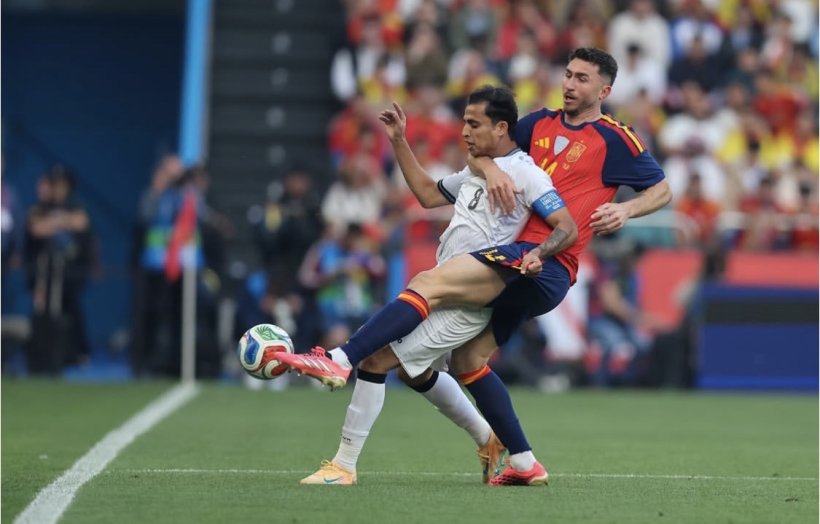
Iraq Achieves a Remarkable Record Against Spain
The Iraqi national team etched its name in golden letters in the records of Arab and Asian football after forcing a 1-1 draw against Spain on Thursday evening at the Riazor Stadium in La Coruña.
This result was not just an ordinary friendly before the 2026 World Cup, but became an unprecedented achievement, as the Lions of Mesopotamia became the first Arab Asian team to draw against the Matador on their home ground and in front of their fans.
Until this moment, no Arab Asian team had managed to win against Spain or even draw with them in the history of official and friendly encounters.
All previous meetings between Arab Asian teams and the Matador ended with a clear Spanish superiority, whether in the World Cup, continental championships, or friendly matches. Iraq today broke this rule and set a new point proving that Arab football can compete with the big teams when will and organization are available.
The match began with a predictable scenario against a team possessing the best football school in possession. Spain controlled the ball from the first minute, imposing their style based on short passes and collective movement without the ball.
The Iraqi team entered the confrontation with a clear plan drawn by Graham Arnold, based on organized retreat and defensive compactness in the midfield, relying on quick transitions whenever the players regained the ball.
The continuous Spanish pressure resulted in a goal in the 17th minute by Ferran Torres, after a series of passes inside the penalty area. The goal gave the Matador the advantage, but it did not break the resilience of the Lions of Mesopotamia. Iraq did not retreat mentally but stuck to the plan and waited for the right moment to respond.
The opportunity came in the 29th minute when Mirhas Doski succeeded in exploiting one of Iraq's few attacks and equalized the score to 1-1. The goal was a culmination of tactical patience and defensive commitment, and it restored the players' confidence that they could match a team that includes the elite stars of the world. The first half ended in a positive draw, amid organized defensive performance from Iraq and a clear advantage for Spain in possession.
At the start of the second half, Spain's coach resorted to making multiple changes in his team's ranks to try out as many players as possible before the World Cup competitions. Arnold responded in kind, giving new elements the opportunity to test their readiness in a match of this magnitude. The playing scenario did not change much; Spain remained superior in ball possession and building attacks, but Iraq showed notable defensive solidity and succeeded in closing spaces in front of the Matador's playmakers.
In periods of the second half, the Lions of Mesopotamia managed to organize the ball out and reach the opponent's areas, confirming the team's development on the physical and mental levels. The Iraqi defense dealt smartly with the movements of Spanish players and did not give them the opportunity to repeat the scenario of the first goal, despite repeated attempts.
The final whistle announced a 1-1 draw, but the most important aspect was the significance of this result. Iraq became the first Arab and Asian team to succeed in stopping Spain on their home ground after decades of absolute Spanish dominance over Arab teams. This record gives Iraqi football a tremendous morale boost before the World Cup, confirming that the team can apply tactical instructions against strong opponents without fear or confusion.
The Spanish camp concluded with an excellent outcome, a victory over Andorra and a historic draw with Spain. The outcome is not measured by numbers alone but by the confidence Arnold instilled in his players and the message sent to all teams that Iraq will not be an easy opponent in its World Cup group against Norway, France, and Senegal.
This result was not just an ordinary friendly before the 2026 World Cup, but became an unprecedented achievement, as the Lions of Mesopotamia became the first Arab Asian team to draw against the Matador on their home ground and in front of their fans.
Until this moment, no Arab Asian team had managed to win against Spain or even draw with them in the history of official and friendly encounters.
All previous meetings between Arab Asian teams and the Matador ended with a clear Spanish superiority, whether in the World Cup, continental championships, or friendly matches. Iraq today broke this rule and set a new point proving that Arab football can compete with the big teams when will and organization are available.
The match began with a predictable scenario against a team possessing the best football school in possession. Spain controlled the ball from the first minute, imposing their style based on short passes and collective movement without the ball.
The Iraqi team entered the confrontation with a clear plan drawn by Graham Arnold, based on organized retreat and defensive compactness in the midfield, relying on quick transitions whenever the players regained the ball.
The continuous Spanish pressure resulted in a goal in the 17th minute by Ferran Torres, after a series of passes inside the penalty area. The goal gave the Matador the advantage, but it did not break the resilience of the Lions of Mesopotamia. Iraq did not retreat mentally but stuck to the plan and waited for the right moment to respond.
The opportunity came in the 29th minute when Mirhas Doski succeeded in exploiting one of Iraq's few attacks and equalized the score to 1-1. The goal was a culmination of tactical patience and defensive commitment, and it restored the players' confidence that they could match a team that includes the elite stars of the world. The first half ended in a positive draw, amid organized defensive performance from Iraq and a clear advantage for Spain in possession.
At the start of the second half, Spain's coach resorted to making multiple changes in his team's ranks to try out as many players as possible before the World Cup competitions. Arnold responded in kind, giving new elements the opportunity to test their readiness in a match of this magnitude. The playing scenario did not change much; Spain remained superior in ball possession and building attacks, but Iraq showed notable defensive solidity and succeeded in closing spaces in front of the Matador's playmakers.
In periods of the second half, the Lions of Mesopotamia managed to organize the ball out and reach the opponent's areas, confirming the team's development on the physical and mental levels. The Iraqi defense dealt smartly with the movements of Spanish players and did not give them the opportunity to repeat the scenario of the first goal, despite repeated attempts.
The final whistle announced a 1-1 draw, but the most important aspect was the significance of this result. Iraq became the first Arab and Asian team to succeed in stopping Spain on their home ground after decades of absolute Spanish dominance over Arab teams. This record gives Iraqi football a tremendous morale boost before the World Cup, confirming that the team can apply tactical instructions against strong opponents without fear or confusion.
The Spanish camp concluded with an excellent outcome, a victory over Andorra and a historic draw with Spain. The outcome is not measured by numbers alone but by the confidence Arnold instilled in his players and the message sent to all teams that Iraq will not be an easy opponent in its World Cup group against Norway, France, and Senegal.
News Related

Iraq Forces a Draw with Spain in Friendly Match
The Iraqi national team achieved a significant moral result on Thursday evening at the stadium

Yemen Defeats Lebanon and Qualifies for the Asian Cup
The Yemeni national team has qualified for the 2027 Asian Cup finals to be held

Youngest Goal Scorers in World Cup History
The statistics network 'Opta' reviewed in its report a list of the youngest

Five Barcelona Players Prepare for Their First World Cup Appearance
Barcelona will be strongly represented at the 2026 World Cup which

The Biggest World Cup Surprises Since 1994
As the 2026 World Cup approaches with 48 teams participating for the first time

Iraq's Expected Lineup Against Spain
The Iraqi national team is preparing to face its Spanish counterpart this evening, Thursday.

Graham Arnold: We Respect Spain but We Came to Test Our Readiness for the World Cup
Australian coach Graham Arnold held a press conference on Wednesday evening.

Younis Mahmoud Heads to Spain to Resolve Two Important Issues
Younis Mahmoud, President of the Iraqi Football Association, embarked on a journey at dawn.

Graham Arnold Prepares Three Trump Cards Before Facing Spain
Australian coach Graham Arnold is putting the final touches on the match strategy

Learn About the Date of the Iraq vs Spain Match
The Iraqi national team will play its second friendly match on the evening of Thursday, June 4, 2026.