


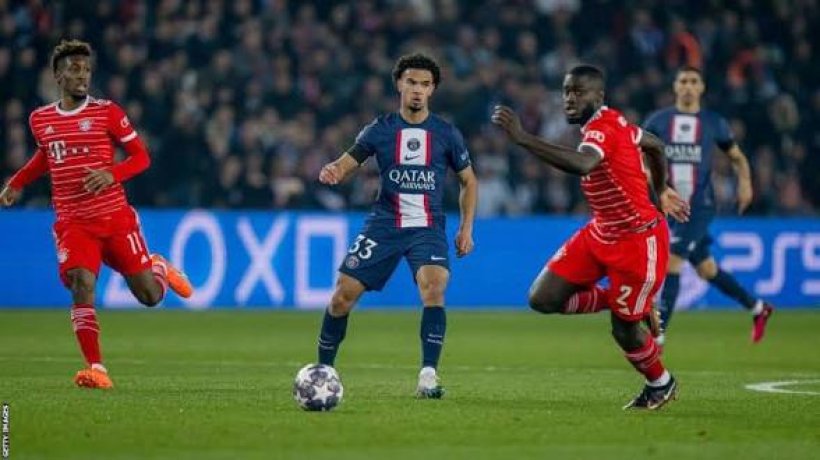
Has Local Dominance Become a European Weapon? Bayern and Paris Change the Equation
All eyes are on the UEFA Champions League semi-final clash between Paris Saint-Germain and Bayern Munich, where two teams that almost completely dominate their domestic leagues will meet.
The Parisian club has won 11 out of the last 13 French league titles, while Bayern continued its dominance by winning the German league title 13 times in the last 14 seasons.
This dominance, along with their significant financial power, has placed them among the elite clubs globally, at a time when the concept of the "big five leagues" has become less clear in favor of the superiority of English Premier League clubs with few European competitors.
For a long time, the lack of local competition was considered a hindrance for these clubs in Europe, as it was said that the absence of challenges made them less prepared against stronger opponents. However, this notion has recently begun to change, especially with the immense pressure of matches in the English Premier League, which is considered the most intense and powerful in terms of physicality and finances.
The enormous economic disparities make even the lower-ranked teams in England stronger than their counterparts in France and Germany, which means that English clubs enter European matches physically and mentally exhausted.
On the other hand, Bayern and Paris benefit from a less demanding schedule, allowing them to rest their players and maintain their readiness during the crucial stages of the season. This factor could be decisive, especially with the increasing number of matches each year. Here, an important shift emerges: the advantage is no longer just for the most "robust" team, but for the one most capable of managing its energy and reaching its peak at the right time.
On the technical level, Paris Saint-Germain has clearly changed under the leadership of Luis Enrique, who built a balanced team that does not rely solely on stars and succeeded in bringing it to its best levels in the knockout stages. Despite some defensive fragility, the attacking power led by players like Ousmane Dembélé was sufficient to decide major encounters, most notably the significant victory over Liverpool.
The situation is similar for Bayern Munich, which sometimes struggles defensively but compensates with a massive attacking force led by Harry Kane, alongside a group of skilled players. The team scores at very high rates, reflecting a philosophy that relies on offense to make up for any gaps. While some English teams are returning to more conservative styles, it seems that Bayern and Paris are making their way in Europe with an enjoyable and effective attacking style.
The Parisian club has won 11 out of the last 13 French league titles, while Bayern continued its dominance by winning the German league title 13 times in the last 14 seasons.
This dominance, along with their significant financial power, has placed them among the elite clubs globally, at a time when the concept of the "big five leagues" has become less clear in favor of the superiority of English Premier League clubs with few European competitors.
For a long time, the lack of local competition was considered a hindrance for these clubs in Europe, as it was said that the absence of challenges made them less prepared against stronger opponents. However, this notion has recently begun to change, especially with the immense pressure of matches in the English Premier League, which is considered the most intense and powerful in terms of physicality and finances.
The enormous economic disparities make even the lower-ranked teams in England stronger than their counterparts in France and Germany, which means that English clubs enter European matches physically and mentally exhausted.
On the other hand, Bayern and Paris benefit from a less demanding schedule, allowing them to rest their players and maintain their readiness during the crucial stages of the season. This factor could be decisive, especially with the increasing number of matches each year. Here, an important shift emerges: the advantage is no longer just for the most "robust" team, but for the one most capable of managing its energy and reaching its peak at the right time.
On the technical level, Paris Saint-Germain has clearly changed under the leadership of Luis Enrique, who built a balanced team that does not rely solely on stars and succeeded in bringing it to its best levels in the knockout stages. Despite some defensive fragility, the attacking power led by players like Ousmane Dembélé was sufficient to decide major encounters, most notably the significant victory over Liverpool.
The situation is similar for Bayern Munich, which sometimes struggles defensively but compensates with a massive attacking force led by Harry Kane, alongside a group of skilled players. The team scores at very high rates, reflecting a philosophy that relies on offense to make up for any gaps. While some English teams are returning to more conservative styles, it seems that Bayern and Paris are making their way in Europe with an enjoyable and effective attacking style.
News Related
Atletico Madrid Targets Lee Kang-in
Atletico Madrid targets Lee Kang-in to strengthen the attacking midfield.
Juventus Expands Its Offensive Options
Juventus inquires about Jesus and Jackson to strengthen the attack.
Jorge Mendes Closes the Door on the Departure of Vitinha and Neves
Vitinha and Joao Neves continue with Paris Saint-Germain.

Chevalier Wanted in England and Turkey
Tottenham and Besiktas inquire about Paris Saint-Germain goalkeeper Chevalier.
9 Candidates for Departure from Manchester City
The British network 'The Athletic' revealed that Manchester City
Bayern and Arsenal in Battle for Frankfurt's Gem
Nathaniel Brown is wanted by Bayern and Arsenal, with an uncertain future.
Matheus Fernandes Makes an Important Decision About His Future
Matheus Fernandes is sought after by major clubs, prefers a developmental project.

Dembele Offers Golden Advice to Mbappe Before the World Cup
Dembele leads the French national team, advising Mbappe to increase his defensive efforts.
Rashford's Stance on Moving to Bayern Munich
Spanish press reports revealed that the English international Marcus Rashford, the winger

Bayern Munich Sets Price for Olise's Departure to Real Madrid
Bayern Munich is asking for 200 million euros to sell Michael Olise.