


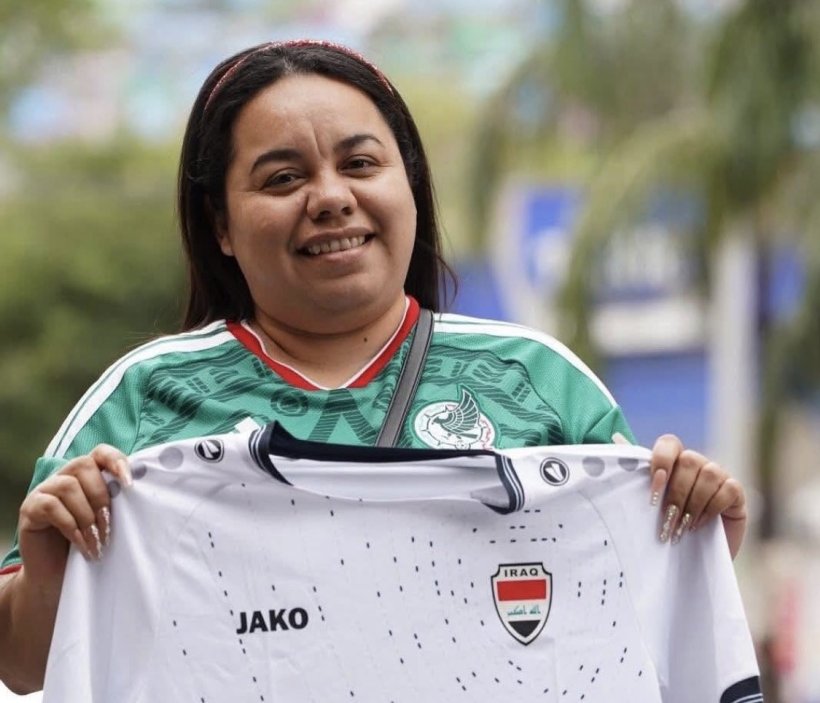
Artificial Intelligence Favors Iraq Against Bolivia in Playoff Final
As the decisive hour approaches in the 2026 World Cup playoff, with its finals set in the United States, Canada, and Mexico between June 11 and July 19 next year, speculations have increased about the identity of the last teams to complete the 48-team lineup for the first time in history.
In this context, a direct question was posed to an artificial intelligence application regarding its predictions for the results of the global playoff finals, and its response brought optimism to Iraqi fans.
The application estimated that the Iraq and Democratic Republic of the Congo teams are the closest to securing the two qualifying spots from the global playoff gateway.
Specifically, it favored the Democratic Republic of the Congo to win against Jamaica in the final of the first path, while giving the advantage to Iraq over Bolivia in the final of the second path, which is taking place in Mexico, specifically at the Monterrey Stadium.
If this anticipated scenario materializes, it will make Iraq the eighth Arab team to reach the 2026 World Cup, following Egypt, Tunisia, Algeria, Morocco, Jordan, Qatar, and Saudi Arabia.
According to circulated information, the "Lions of Mesopotamia" will be placed in Group Nine in the draw, alongside France, Norway, and Senegal, in a group that promises many technical and physical challenges.
On the field, Iraq's team reached the final of the second path directly, benefiting from its good position in the FIFA ranking, which spared the team the trouble of playing the semi-final.
In contrast, Bolivia's team made its way to the final after defeating Suriname 2-1 in the semi-final of the same path, setting up a decisive match against Iraq.
The technical estimate issued by artificial intelligence does not negate the realities on the ground; the match will be decided by small details and the degree of focus and tactical discipline over the ninety minutes, and possibly extra time.
The Lions of Mesopotamia are betting on the readiness of their players, derived from the continuation of local competitions, and on the solidity of the group that has gained cumulative experiences in recent months, while the Bolivian opponent relies on its Latin style and ability to exploit spaces.
News Related

Graham Arnold Identifies Positive Point from Venezuela Friendly
The Iraqi national team concluded their preparations for the 2026 World Cup with a loss to Venezuela.

Arnold Faces Test to Restore Defense: Five Flaws Revealed by Venezuela Friendly
The Iraqi national team enters the 2026 World Cup scheduled in the United States

Controversy Accompanies Iraq After Loss to Venezuela Before World Cup Kickoff
The Iraqi national team fell in its last friendly match before the World Cup.

Algerian Television Apologizes for Not Broadcasting Bolivia Friendly
Algerian television will not broadcast the friendly match between Algeria and Bolivia.

Iraq Falls to Venezuela by Two Goals in Friendly Match
The Iraqi national team concluded its series of friendly matches before the 2026 World Cup.

Who is Iraq's Next Opponent? Meet the Venezuelan National Team
Before the Lions of Mesopotamia play their final friendly match against Venezuela

Iraq's Expected Lineup in the Friendly Against Venezuela
The Iraqi national team is preparing to play its last friendly match against its Venezuelan counterpart.

Senegalese Federation Clarifies Truth About Video of Players Being Searched at Airport
The Senegalese Federation clarifies the circumstances surrounding the national team's search at the airport.

Iraq Duo Ignite Atmosphere Ahead of Venezuela Clash
The duo Ahmed Hassan Mkanzi and Rebin Sulaka raised the level of enthusiasm in

Revealing the Referee for the Iraq vs. Venezuela Match
The American Federation's Referees Committee entrusted the management of the friendly match