


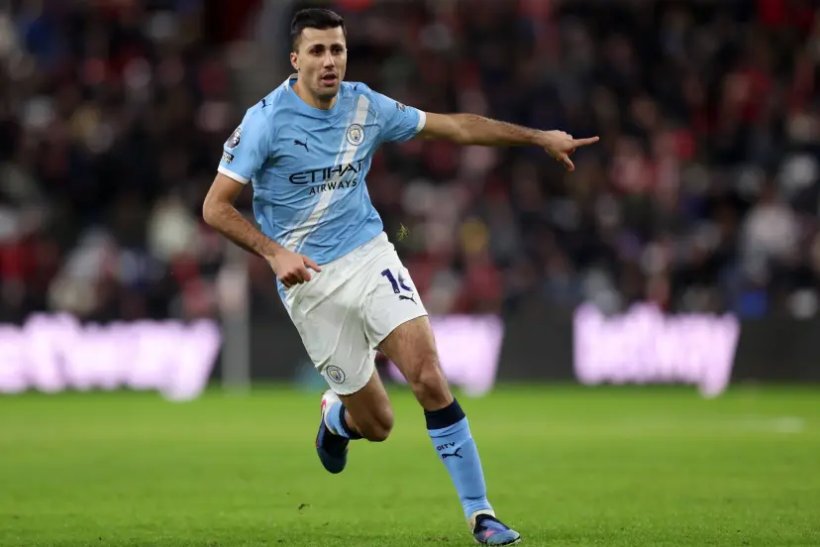
Rodri, a Return That Changes Everything
Rodri Hernández has returned, and it was no ordinary comeback. He is a player who makes everyone around him better—a vital piece that Manchester City had long missed, a calm leader who has overcome the toughest phase of his career. After harsh months filled with injuries, waiting, and quiet hard work, Rodri has come back feeling like a footballer once again… returning fully recovered and stronger than ever.
The Spanish midfielder went through a very difficult period, facing a series of physical problems and managing to play only 415 minutes across eight matches this season. His last appearance before the break was on November 2nd, and since then, he began a long and arduous recovery journey. He later returned to the team’s squad for the match against Nottingham Forest in the 2-1 victory but did not play. That was the first sign… an indication that the end of the tunnel was near.
The confirmation came against Sunderland. Guardiola decided to bring on Rodri at the start of the second half, replacing Nico González, who had delivered impressive performances. In just 45 minutes, Rodri reasserted his influence. He organizes the play, provides balance to the team, and offers solutions when the team needs them most. Without a full competitive rhythm or continuity, but with an unchanging authority.
Pep Guardiola did not hesitate to consider him the best player in the second half, explaining the impact of his absence on the team: "Rodri changed the game. In 45 minutes, he proved to be the best in his position. We struggled to build up play, and with Rodri, we struggled less. He broke the lines, we became smoother and moved better... We missed him. He makes us a better team."
The numbers confirmed this sense of immediate control; Rodri led the match in completed passes (52), passes in the opponent’s half (28), and line-breaking passes (7). He was the true maestro from his very first touch. City breathed a sigh of relief… despite settling for a draw, because the team’s midfield returned to its natural position.
From now on, the plan is clear: caution, managing the minutes, and gradually increasing the load, as Guardiola insists on the need to protect the player after a long absence. But the truth is that Rodri has passed the most important step—he has recovered, both physically and mentally. He has returned with confidence, calmness, and without fear.
And this is not just good news for Manchester City, but also for the Spanish national team. Rodri is a key element in Luis de la Fuente’s system, the player who balances the team, organizes it, and gives it meaning. His full recovery comes at a perfect time, with the World Cup approaching and Spain needing their pivot in top form. When Rodri is well, everything falls into place… at City, in Spain, and in football.
Additionally, it should not be forgotten that Rodri Hernández will enter the final year of his contract with Manchester City next summer, which Real Madrid might try to take advantage of to sign him. This is a familiar scenario for the royal club, which is used to engaging in such situations to reduce costs. If the player reaches this stage without renewing his contract, the English club will find itself forced to consider selling him to avoid the risk of losing him for free after just one year.
The Spanish midfielder went through a very difficult period, facing a series of physical problems and managing to play only 415 minutes across eight matches this season. His last appearance before the break was on November 2nd, and since then, he began a long and arduous recovery journey. He later returned to the team’s squad for the match against Nottingham Forest in the 2-1 victory but did not play. That was the first sign… an indication that the end of the tunnel was near.
The confirmation came against Sunderland. Guardiola decided to bring on Rodri at the start of the second half, replacing Nico González, who had delivered impressive performances. In just 45 minutes, Rodri reasserted his influence. He organizes the play, provides balance to the team, and offers solutions when the team needs them most. Without a full competitive rhythm or continuity, but with an unchanging authority.
Pep Guardiola did not hesitate to consider him the best player in the second half, explaining the impact of his absence on the team: "Rodri changed the game. In 45 minutes, he proved to be the best in his position. We struggled to build up play, and with Rodri, we struggled less. He broke the lines, we became smoother and moved better... We missed him. He makes us a better team."
The numbers confirmed this sense of immediate control; Rodri led the match in completed passes (52), passes in the opponent’s half (28), and line-breaking passes (7). He was the true maestro from his very first touch. City breathed a sigh of relief… despite settling for a draw, because the team’s midfield returned to its natural position.
From now on, the plan is clear: caution, managing the minutes, and gradually increasing the load, as Guardiola insists on the need to protect the player after a long absence. But the truth is that Rodri has passed the most important step—he has recovered, both physically and mentally. He has returned with confidence, calmness, and without fear.
And this is not just good news for Manchester City, but also for the Spanish national team. Rodri is a key element in Luis de la Fuente’s system, the player who balances the team, organizes it, and gives it meaning. His full recovery comes at a perfect time, with the World Cup approaching and Spain needing their pivot in top form. When Rodri is well, everything falls into place… at City, in Spain, and in football.
Additionally, it should not be forgotten that Rodri Hernández will enter the final year of his contract with Manchester City next summer, which Real Madrid might try to take advantage of to sign him. This is a familiar scenario for the royal club, which is used to engaging in such situations to reduce costs. If the player reaches this stage without renewing his contract, the English club will find itself forced to consider selling him to avoid the risk of losing him for free after just one year.
News Related

Amid Uncertainty About His Future.. Alvarez's Preferred Destination Revealed
Italian journalist Matteo Moretto revealed during his appearance on the program 'La'...
Vlahovic Offered to Real Madrid, Barcelona, and Atletico Madrid
Vlahovic has been presented to European clubs as a free transfer deal.

English Struggle to Sign Real Madrid Star
Arsenal and Liverpool have entered the race with Chelsea to
Rüdiger Reaches Agreement with Real Madrid on Contract Renewal
The renewal of German defender Antonio Rüdiger's contract with Real Madrid
Real Madrid's Statement Surprises Mourinho
Mourinho is surprised by Real Madrid's offer for Alvarez.

A State of Tension and Anxiety Inside Real Madrid's Dressing Room
Real Madrid's dressing room is experiencing a state of tension and anxiety with

Vinicius Decides to Stay at Real Madrid and Plans to Leave for Free
Vinicius Junior decides to continue with Real Madrid until 2027.

Jorge Mendes Closes the Door on the Departure of Vitinha and Neves
Vitinha and Joao Neves continue with Paris Saint-Germain.
Official: Benfica Announces Mourinho's Departure to Real Madrid and Reveals His Successor
Mourinho leaves Benfica, Marco Silva takes over the team's coaching.
Atletico Madrid Responds to Real Madrid's Statement
Atletico Madrid rejects Real Madrid's offer to sign Julian Alvarez.