


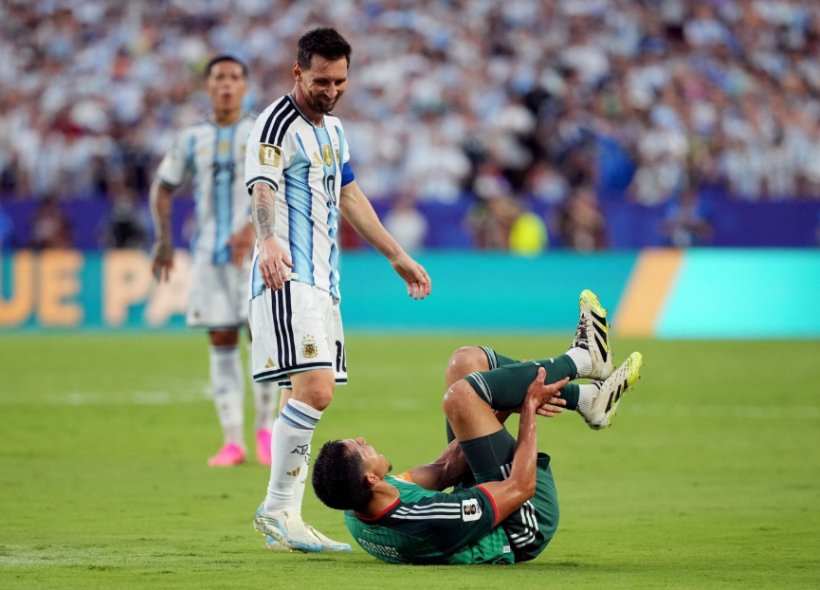
A Storm of Criticism Targets Officiating in Messi and Mandi Incident
The debate continued intensely over the incident involving Argentine star Lionel Messi and Algerian defender Aïssa Mandi during the Argentina match in the 2026 World Cup, after several former football stars joined the criticism directed at the refereeing and the Video Assistant Referee (VAR) technology.
The beginning came from former Manchester United player Roy Keane, who expressed his anger at the media and refereeing handling of the incident, saying: "After the match, all we see is praise for Messi and headlines about the hat-trick, but no one wants to talk about what actually happened."
Kane added sharply: "That tackle was an absolute disgrace, coming in late with the studs raised directly towards the Achilles tendon, an area that could end any player's career," before asserting that the situation warranted a straight red card without hesitation, suggesting that Messi's name might have been the reason for avoiding the penalty.
The former player emphasized that refereeing fairness must be absolute in the World Cup, saying: "This is a tournament where the rules should be applied to everyone without exception or discrimination because of a player's name," adding that what happened was "a refereeing joke on the biggest stage in football."
For his part, former Welsh star Gareth Bale joined the wave of criticism, asserting that the tackle deserved a red card. He expressed his surprise at the referee and VAR's disregard of the incident, pointing out that commercial pressures and sponsors' interests might sometimes influence certain decisions on the pitch.
In turn, Portuguese Luis Nani considered the incident to be beyond any debate, saying it was "a very clear red card," expressing his astonishment at the VAR not intervening to review the situation, and emphasizing that the application of the rules should be uniform regardless of the player's identity or name.
The Dutchman Clarence Seedorf also commented on the incident, directing direct criticism at the refereeing system, saying that such decisions "make people lose trust in FIFA and VAR technology," noting that a single refereeing error may not only affect a match but could change the course of the entire tournament and determine the identity of the world champion.
The widespread controversy over the incident continues, with a significant divide between those who believe the refereeing was not strict enough and those who think the incident was taken out of context. Meanwhile, Messi's name remains at the center of an unrelenting storm of debate within the corridors of the World Cup.
The beginning came from former Manchester United player Roy Keane, who expressed his anger at the media and refereeing handling of the incident, saying: "After the match, all we see is praise for Messi and headlines about the hat-trick, but no one wants to talk about what actually happened."
Kane added sharply: "That tackle was an absolute disgrace, coming in late with the studs raised directly towards the Achilles tendon, an area that could end any player's career," before asserting that the situation warranted a straight red card without hesitation, suggesting that Messi's name might have been the reason for avoiding the penalty.
The former player emphasized that refereeing fairness must be absolute in the World Cup, saying: "This is a tournament where the rules should be applied to everyone without exception or discrimination because of a player's name," adding that what happened was "a refereeing joke on the biggest stage in football."
For his part, former Welsh star Gareth Bale joined the wave of criticism, asserting that the tackle deserved a red card. He expressed his surprise at the referee and VAR's disregard of the incident, pointing out that commercial pressures and sponsors' interests might sometimes influence certain decisions on the pitch.
In turn, Portuguese Luis Nani considered the incident to be beyond any debate, saying it was "a very clear red card," expressing his astonishment at the VAR not intervening to review the situation, and emphasizing that the application of the rules should be uniform regardless of the player's identity or name.
The Dutchman Clarence Seedorf also commented on the incident, directing direct criticism at the refereeing system, saying that such decisions "make people lose trust in FIFA and VAR technology," noting that a single refereeing error may not only affect a match but could change the course of the entire tournament and determine the identity of the world champion.
The widespread controversy over the incident continues, with a significant divide between those who believe the refereeing was not strict enough and those who think the incident was taken out of context. Meanwhile, Messi's name remains at the center of an unrelenting storm of debate within the corridors of the World Cup.
News Related

Mandi Comments on Algeria's Start: "It Was Difficult But We Won't Give Up"
Mandi Confirms the Challenge After Algeria's Loss to Argentina in the World Cup.

Marcelo: Messi Deserved to Be Sent Off Against Algeria
Marcelo Sparks Controversy Over Refereeing in Big Stars' Matches.

What Did the First Round of the 2026 World Cup Reveal?
Surprising Results and Open Competition in the 2026 World Cup.

Ronaldo Settles the Debate: Messi is the Best in Football History
Ronaldo describes Messi as the greatest in football history.

Danilo: We Lack Maturity Compared to France and Argentina
Danilo: Brazil lacks maturity compared to France and Argentina.

Revealing the Reason Behind Messi's Tears Against Algeria
The tears of legend Lionel Messi during Argentina's match against

Thierry Henry: What Messi Does Surpasses Greatness
Messi Equals Klose, Henry Praises His Historical Greatness.

Petkovic Praises Messi: Sometimes You Have to Acknowledge Greatness When You See It
Messi was exceptional against Algeria, scoring a hat-trick and managing the match.

Deschamps: What Messi Does Cannot Be Analyzed
Deschamps praises Messi after a historic hat-trick against Algeria.

Al-Salami: The Result Does Not Reflect the True Face of the Nashama
The defeat does not reflect Jordan's performance, preparing for the match against Algeria.