

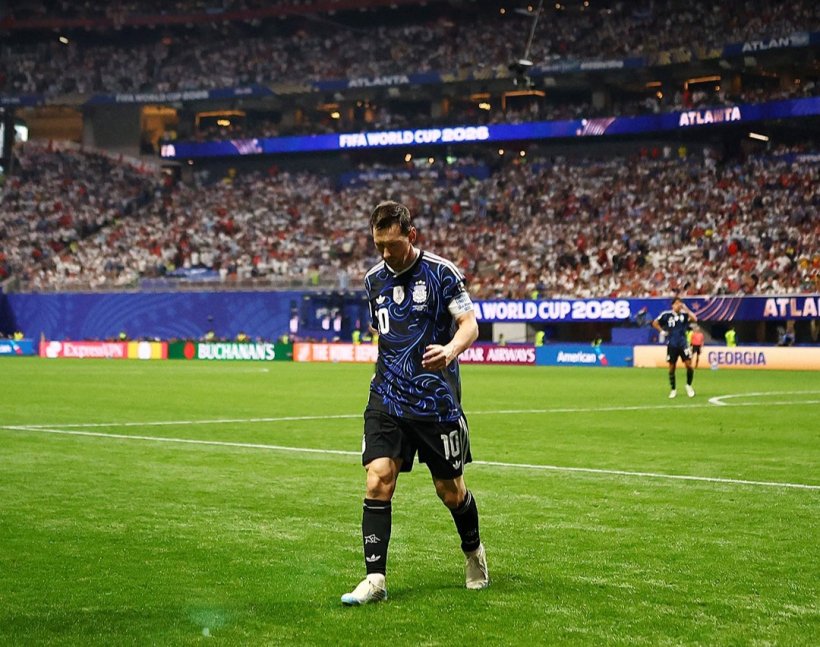
Messi: The King of Football Who Turned Walking into a New Weapon in the Game
In an era where football relies more than ever on speed, physical strength, and relentless pressing, Lionel Messi has emerged to present a completely different theory; instead of constantly chasing the ball, he chooses to control the game with his eyes before his feet, turning calmness into a weapon and waiting for the moment to explode.
The British newspaper The Telegraph has spotlighted the phenomenon that Argentine star Lionel Messi represents in the 2026 World Cup, describing him as the 'undisputed king of walking football,' referring to his unique style of managing his energy and movements on the pitch.
While many believe that an aging player needs to exert more effort and movement to prove their worth, Messi does the exact opposite. At 39 years old, the Argentina captain is still capable of making a difference on the biggest football stage in the world, not because he runs more than everyone else, but because he knows when to move, where to position himself, and when to deliver the decisive blow.
Genius in reading the game is crucial for players and coaches alike. Understanding the flow of the match can lead to better decision-making and ultimately, success on the pitch.
When you watch Messi without focusing on the ball, you discover another side of his genius. He spends long periods standing or walking, but he is not as distant from the game as he may seem; rather, he observes the positioning of defenders, reads the spaces, and tracks the movements of his teammates and opponents, as if he is analyzing the match before the right moment arrives.
Statistics indicate that Messi covered large distances during the tournament, but most of it was at low speeds; he spent about 64% of his time on the field in slow movement or walking. This figure, which may seem strange for a global star, has become evidence of a different way of thinking about football.
Messi is no longer a player who relies on repeated sprints for 90 minutes; he has become a specialist in "short bursts": a single touch that changes the direction of play, a pass that breaks through an entire defensive line, or a shot that seals the match.
Energy management is crucial for athletes and teams aiming to maintain peak performance. By optimizing their physical and mental energy, they can ensure consistent results and longevity in their careers. This approach not only enhances individual performance but also contributes to the overall success of the team. Coaches and sports scientists emphasize the importance of energy management strategies to keep players at their best throughout the season.
In modern football, players are expected to press and move constantly, but Messi has proven that tactical intelligence can sometimes overcome physical demands.
Coach Lionel Scaloni has built Argentina's system in a way that grants Messi greater freedom, as his teammates take on a significant portion of the physical workload, while the captain conserves energy for the moments when the team needs his genius.
This is not a sign of weakness or decline, but a natural evolution of a player who understands his body and the game to the fullest. Messi no longer needs to win physical battles, as he has started winning mental ones before they even begin.
In the world of football, there are players who can change the game without breaking a sweat. This player is a prime example of that. His ability to read the game and position himself perfectly makes him a constant threat, even when he appears to be stationary. Coaches often marvel at how he can create opportunities without the need for excessive movement.
Lionel Messi has always been one of the best dribblers, playmakers, and finishers in the world, but what sets his current version apart is his ability to choose the right moment.
Competitors may pass the ball dozens of times, and Messi might seem out of the picture, but suddenly he becomes the most dangerous player on the field in just a few seconds. One step into the right space can be enough to unlock an entire defense.
Here lies the paradox: the least physically active player can be the most influential. Physical statistics do not always explain a player's value, as football is not just a race; it is a game of decisions.
Lionel Messi remains a remarkable figure in football, showcasing skills and agility that challenge the typical expectations of aging athletes. Despite being in the latter stages of his career, Messi's ability to influence games and deliver exceptional performances has not waned. His vision, dribbling, and goal-scoring prowess keep him at the forefront of the sport, proving that age is just a number for this footballing icon.
Never before in World Cup history has a player of this age maintained such a level of influence. After years of pressure, criticism, and the quest for the global title, Messi has become a symbol of experience, maturity, and leadership.
In the past, the question was: Can Messi lead Argentina to glory?
Today, after winning the 2022 World Cup and reaching the 2026 final, the question is different: how can a player of this age remain decisive against the best teams in the world?
The answer may lie in his personal philosophy: you don't always need to move more to be the best; sometimes you just need to move at the right moment.
Messi has turned walking into an art form, silence on the pitch into a method of control, and waiting into a lethal weapon. In an era where everyone chases speed, the Argentine star has demonstrated that football genius can sometimes lie in the ability to pause for a moment... then explode when the whole world is unprepared.
View Comments