

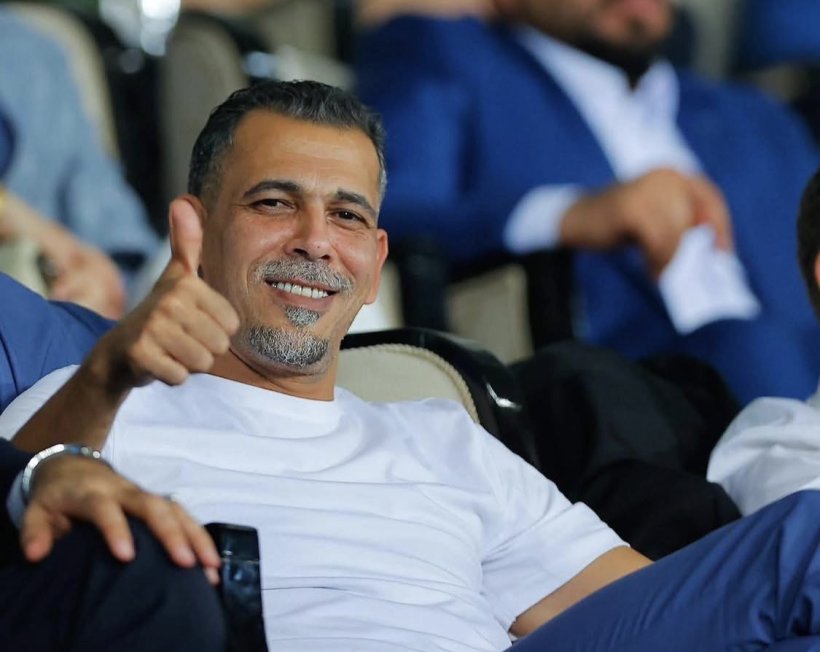
Officially: Younis Mahmoud Wins Presidency of the Iraqi Football Association
Former international star Younis Mahmoud secured the presidency of the Iraqi Football Association after his sweeping victory in the executive office elections held today, Saturday, in Baghdad. He surpassed his competitors Adnan Darjal and Iyad Bunyan from the first round.
Mahmoud received 38 votes out of 59, compared to 20 votes for Adnan Darjal, and a single vote for Iyad Bunyan, declaring himself the president of the association for the upcoming term extending until 2030, after serving as the second vice president in the previous term.
Younis Mahmoud's victory came after an electoral campaign that focused on the concept of teamwork and restructuring decision-making mechanisms within the association. Mahmoud, who was one of the most prominent critics of Darjal's previous administration, considered that unilateral decision-making and the lack of consultation with executive office members were among the reasons for the decline in administrative performance, asserting that the upcoming phase will be different.
In his first statement after the victory, he said: "I thank the trust of the general assembly members, this is a great responsibility and I am ready for it. We will put the necessary plans to improve the reality of Iraqi football, and the work program will be presented to the executive office members for discussion and approval in a participatory manner that reflects the spirit of one team."
The new term for Younis Mahmoud will be governed by two major files that define the phase: competing for the 2027 Asian Cup title hosted by Saudi Arabia, and striving to qualify for the 2030 World Cup, to be the third participation in the history of the Lions of Mesopotamia after the 1986 and 2026 editions.
Mahmoud's electoral program focused on developing local competitions, reforming the age group system, and strengthening the relationship between the association, clubs, and coaches, with the involvement of executive office members in decision-making instead of concentrating it in the hands of the president.
Mahmoud's victory raises a big question mark about Adnan Darjal's role during the upcoming period, especially regarding overseeing the national team. Darjal had previously announced his intention to accompany the team to the Spain camp and supervise its preparations for the 2026 World Cup, but he is now outside the administrative system of the association and does not have an official capacity to attend in that role.
It is noteworthy that Darjal's most significant achievements during his presidency were bringing Iraq back to the World Cup after a 40-year absence and winning the Gulf Cup 25 held in Basra, which made the election race a confrontation between two different projects in managing Iraqi football.
Mahmoud received 38 votes out of 59, compared to 20 votes for Adnan Darjal, and a single vote for Iyad Bunyan, declaring himself the president of the association for the upcoming term extending until 2030, after serving as the second vice president in the previous term.
Younis Mahmoud's victory came after an electoral campaign that focused on the concept of teamwork and restructuring decision-making mechanisms within the association. Mahmoud, who was one of the most prominent critics of Darjal's previous administration, considered that unilateral decision-making and the lack of consultation with executive office members were among the reasons for the decline in administrative performance, asserting that the upcoming phase will be different.
In his first statement after the victory, he said: "I thank the trust of the general assembly members, this is a great responsibility and I am ready for it. We will put the necessary plans to improve the reality of Iraqi football, and the work program will be presented to the executive office members for discussion and approval in a participatory manner that reflects the spirit of one team."
The new term for Younis Mahmoud will be governed by two major files that define the phase: competing for the 2027 Asian Cup title hosted by Saudi Arabia, and striving to qualify for the 2030 World Cup, to be the third participation in the history of the Lions of Mesopotamia after the 1986 and 2026 editions.
Mahmoud's electoral program focused on developing local competitions, reforming the age group system, and strengthening the relationship between the association, clubs, and coaches, with the involvement of executive office members in decision-making instead of concentrating it in the hands of the president.
Mahmoud's victory raises a big question mark about Adnan Darjal's role during the upcoming period, especially regarding overseeing the national team. Darjal had previously announced his intention to accompany the team to the Spain camp and supervise its preparations for the 2026 World Cup, but he is now outside the administrative system of the association and does not have an official capacity to attend in that role.
It is noteworthy that Darjal's most significant achievements during his presidency were bringing Iraq back to the World Cup after a 40-year absence and winning the Gulf Cup 25 held in Basra, which made the election race a confrontation between two different projects in managing Iraqi football.
News Related

Younis Mahmoud Decides the Fate of Graham Arnold's File
Younis Mahmoud, the new president of the Iraqi Football Association, reassures the coach
Younis Mahmoud Sets His Goals After Assuming Presidency of the Federation
Younis Mahmoud, the former international star and second deputy in the administration

Norway Announces its Official Squad for the World Cup
The coaching staff of the Norwegian national team announced the final squad called up to participate

Iraq Faces Three Critical Tests in Gulf Cup 27
Coach Saad Hafiz believes that the Iraqi national team will face a difficult task

Ayman Hussein: Qualifying for the World Cup was a dream and we will play with a spirit that knows no impossibility
The star of the Iraqi national team, Ayman Hussein, expressed his overwhelming happiness after

Adnan Darjal Settles the Debate Regarding Montadhar Al-Majid
Adnan Darjal, President of the Iraqi Football Association, has settled the ongoing debate
Al-Zaidi Receives the Iraqi National Team Delegation Before Heading to Spain
Iraqi Prime Minister Ali Al-Zaidi today received the national team delegation
Announcement of Senegal's World Cup Squad
The official unveiling of the Senegal national team's squad took place today, Thursday.
Exceptional Deal from Mamdani with FIFA
World Cup tickets at a discounted price exclusively for New York residents.

Hotels in the United States in Trouble Before the World Cup
A significant gap between expectations and bookings for the 2026 World Cup hotels.