

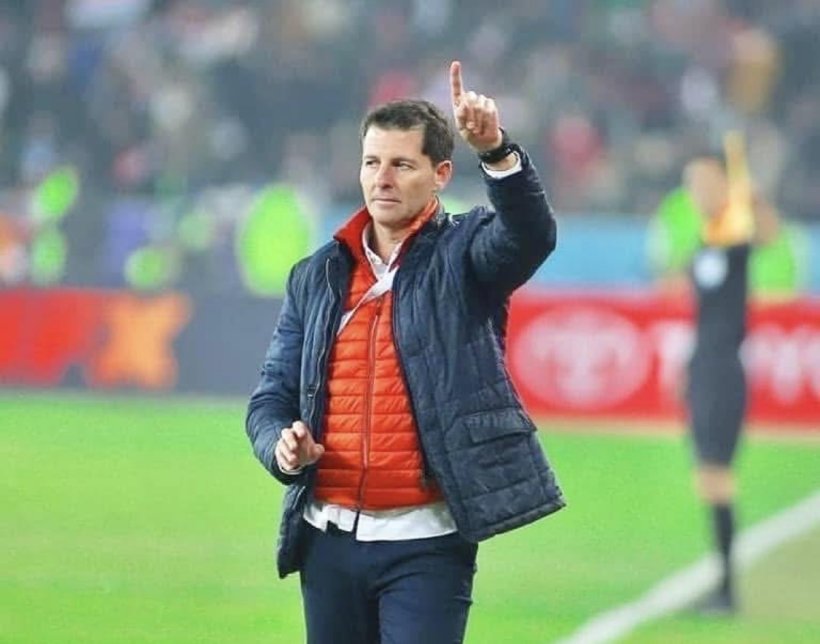
Jesus Casas Refuses to Bear Responsibility for Failure with Iraq
The Spanish coach Jesus Casas sparked widespread controversy with his recent statements in which he refused to bear responsibility for the Iraqi national team's failure to qualify for the 2026 World Cup, asserting that his journey with the 'Lions of Mesopotamia' witnessed significant technical and administrative development before he left the position.
Casas led the Iraqi national team from November 5, 2022, until March 26, 2025, during which he supervised 33 matches, achieving 20 victories, 4 draws, and 9 losses, a numerical result that the Spanish coach considered evidence of the work he provided with the team.
Casas said in media statements: 'Honestly, we were brave in accepting to coach Iraq, and we came to develop Iraqi football on both the administrative and technical levels, and I believe the results prove that; we defeated Japan, and we won against Oman in Muscat, but unfortunately, the Iraqi Federation did not allow us to complete our mission with the team.'
He added: 'When I left coaching Iraq, the situation allowed for direct qualification to the World Cup, and that was possible if the team did not lose in Basra against South Korea, but this did not happen. Even in the Asian playoffs, it was possible to achieve a good result against Indonesia and then draw with Saudi Arabia.'
The Spanish coach clarified his stance on being held responsible for the failure, saying: 'During my period as coach of the Iraqi national team, I managed to achieve victory over the Indonesian team twice with scores of 5-1 and 3-1, and if I had stayed, I would have also won against them in the Asian playoff; therefore, I refuse to be held responsible for Iraq's failure to qualify due to the loss against Palestine.'
He continued his talk, revealing some behind-the-scenes details: 'Unfortunately, in my last period, the relationship between the technical staff and the Iraqi Federation witnessed hidden aspects I was not aware of, and frankly, my confidence in the independence of my technical decision was shaken after learning about certain actions that happened behind the scenes, which sparked widespread controversy in Iraq.'
In a related context, Casas spoke about the role of the team supervisor, saying: 'The supervisor of the Iraqi national team, Younis Mahmoud, was always offering advice to the technical staff and the Iraqi team, and on one occasion, he advised against participating in the recent (Gulf 26) tournament in Saudi Arabia, especially after the Federation's decision to call up only two players from each club to continue the league, alongside the absence of some professionals.'
Casas led the Iraqi national team from November 5, 2022, until March 26, 2025, during which he supervised 33 matches, achieving 20 victories, 4 draws, and 9 losses, a numerical result that the Spanish coach considered evidence of the work he provided with the team.
Casas said in media statements: 'Honestly, we were brave in accepting to coach Iraq, and we came to develop Iraqi football on both the administrative and technical levels, and I believe the results prove that; we defeated Japan, and we won against Oman in Muscat, but unfortunately, the Iraqi Federation did not allow us to complete our mission with the team.'
He added: 'When I left coaching Iraq, the situation allowed for direct qualification to the World Cup, and that was possible if the team did not lose in Basra against South Korea, but this did not happen. Even in the Asian playoffs, it was possible to achieve a good result against Indonesia and then draw with Saudi Arabia.'
The Spanish coach clarified his stance on being held responsible for the failure, saying: 'During my period as coach of the Iraqi national team, I managed to achieve victory over the Indonesian team twice with scores of 5-1 and 3-1, and if I had stayed, I would have also won against them in the Asian playoff; therefore, I refuse to be held responsible for Iraq's failure to qualify due to the loss against Palestine.'
He continued his talk, revealing some behind-the-scenes details: 'Unfortunately, in my last period, the relationship between the technical staff and the Iraqi Federation witnessed hidden aspects I was not aware of, and frankly, my confidence in the independence of my technical decision was shaken after learning about certain actions that happened behind the scenes, which sparked widespread controversy in Iraq.'
In a related context, Casas spoke about the role of the team supervisor, saying: 'The supervisor of the Iraqi national team, Younis Mahmoud, was always offering advice to the technical staff and the Iraqi team, and on one occasion, he advised against participating in the recent (Gulf 26) tournament in Saudi Arabia, especially after the Federation's decision to call up only two players from each club to continue the league, alongside the absence of some professionals.'
News Related

Iraq Faces Venezuela in a Friendly Before the World Cup
Babylon Talent Agency announced the completion of an official agreement to hold

Iraq Monitors a New Professional in England
The Iraqi Football Association continues through the Expatriates Committee to search for

Good News in Iraq's Squad for the 2026 World Cup
Australian Graham Arnold, the coach of the Iraqi national team, is preparing to reveal the squad.

Adnan Darjal Clarifies Updates on US Entry Visas
The President of the Iraqi Football Association, Adnan Darjal, confirmed that the work

Could the World Cup be the most environmentally polluting sports event in history?
The 2026 World Cup is threatened to become the most environmentally polluting.

Arnold: No Fear of the Giants... We Believe in Surprises at the World Cup
Arnold: Australia is Capable of Surprising in the World Cup with Focus and Mentality.

The Reason Behind the Postponement of Iraq's World Cup Squad Announcement
The Iraqi national team enters a new phase of preparation in the coming days.

Complacency is Iraq's Enemy in the 2027 Asian Cup
The Iraqi national team is preparing to participate in the 2027 Asian Cup scheduled in

Graham Arnold: We Are Preparing for the World Cup and Strive to Appear in the Best Form
The coach of the Iraq national team, Graham Arnold, confirmed that the technical staff is working

Date for Iraqi Players to Join Spain Camp
The coaching staff of the Iraqi national team, led by Graham Arnold, has settled on the program.