


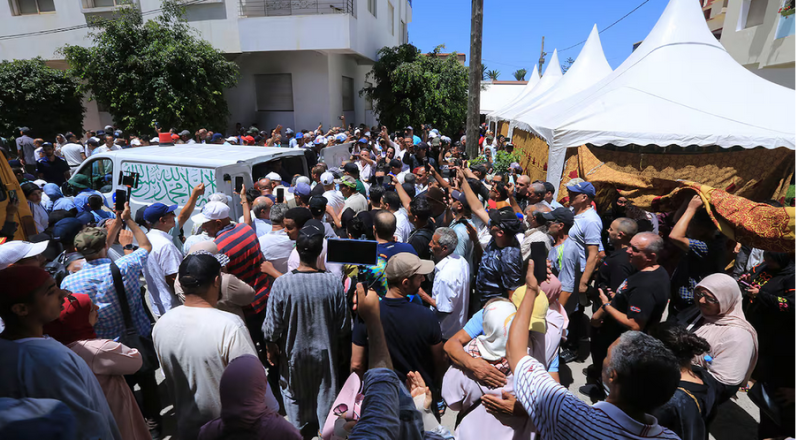
A Grand Funeral for Ahmed Faras in Mohammedia with a Large Public Attendance
This morning, Thursday, the city of Mohammedia witnessed the funeral ceremony of the Moroccan football legend Ahmed Faras, to his final resting place at Al-Naseem Cemetery, amidst a grand funeral procession attended by hundreds of citizens, as well as prominent sports and media figures, in a touching farewell moment for "Moul Al-Koura."
Ahmed Faras, the first captain of the Moroccan national team to win the Africa Cup, passed away at the age of 79 after a long battle with illness, having died in his home on Wednesday evening in Mohammedia, where he was born and raised, and where he was known as a player and a national sports symbol.
The funeral procession began from the late man's home, where a large number of the city's residents and football fans gathered to bid farewell to one of the most prominent names that marked the history of Moroccan football.
Ahmed Faras is considered a pivotal figure in the history of national football, having led the Moroccan national team to victory in the Africa Cup of Nations in 1976, and was an exceptional scorer and captain. He also won the African Golden Ball in 1975 and is regarded as one of the symbols of Chabab Mohammedia.
Ahmed Faras, the first captain of the Moroccan national team to win the Africa Cup, passed away at the age of 79 after a long battle with illness, having died in his home on Wednesday evening in Mohammedia, where he was born and raised, and where he was known as a player and a national sports symbol.
The funeral procession began from the late man's home, where a large number of the city's residents and football fans gathered to bid farewell to one of the most prominent names that marked the history of Moroccan football.
Ahmed Faras is considered a pivotal figure in the history of national football, having led the Moroccan national team to victory in the Africa Cup of Nations in 1976, and was an exceptional scorer and captain. He also won the African Golden Ball in 1975 and is regarded as one of the symbols of Chabab Mohammedia.
News Related

Messi Tops the List of Most Participating Players in World Cup History
Messi leads the list of players with the most appearances in World Cup history.
The Highest Scoring World Cup Matches in History
A look at the World Cup matches with the most goals scored throughout history.

El-Hadary Tops the List of Oldest Players in World Cup History
Opta statistics network highlighted the list of oldest players

Oldest Goal Scorers in World Cup History
The 'Opta' statistics network highlighted the list of the oldest players.

The Youngest Players in World Cup History
The 'Opta' statistics network highlighted the list of the youngest players who

Portugal Concludes World Cup Preparations with a Tough Win Over Nigeria
Portugal defeats Nigeria 2-1 in preparation for the 2026 World Cup.

Al-Wehda Announces Contract with Brazilian Coach Péricles Chamusca
Al-Wehda signs Brazilian coach Chamusca for the 2026-2027 season.

Fulham in Official Talks with Arbeloa
Fulham negotiates with Arbeloa to take over the team's coaching.

FIFA Requests Haiti to Modify Its Jersey
FIFA requests Haiti to modify its jersey for the 2026 World Cup.

New Developments Regarding Coach José Gomes Case
Zamalek provides 50% of the dues to coach José Gomes.