






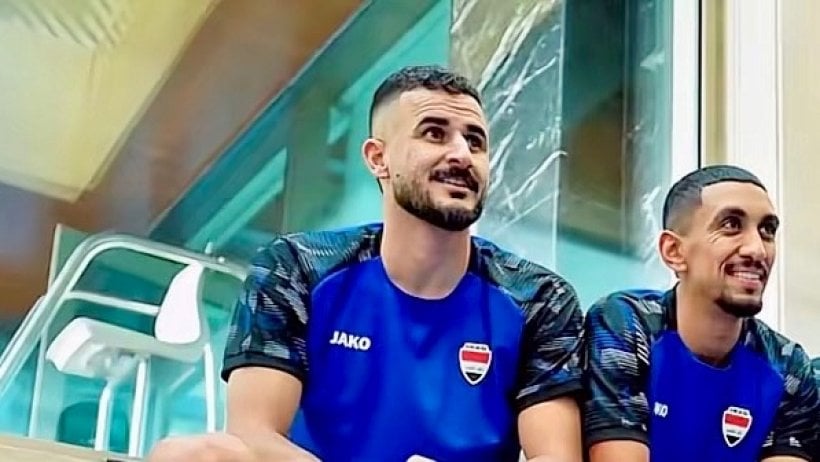
What is the reason behind Aymen Hussein's poor performance against Lebanon?
The celebratory night honoring Iraq national team captain Aymen Hussein for entering the 100-cap club was not enough to hide the questions raised about the overall performance of the Lions of Mesopotamia and their top scorer's contribution, following the disappointing goalless draw against the Lebanon national team this Friday evening at the Basra International Stadium, at the start of the Basra International Four-Nation Friendly Tournament.
In a celebratory scene before the kickoff, the Iraqi Football Association honored Aymen Hussein with a commemorative shield and a special shirt bearing the number 100, in recognition of his illustrious career and significant contributions after reaching the milestone of 100 international matches. He is set to play his 101st match today in the national team shirt.
Despite being a key player and the main source of danger in Iraq's attack, the veteran striker performed below average; his headers and limited attempts lacked precision and decisiveness in front of the Lebanese goal, leading him to leave the pitch in the second half without being able to crown his special night with a goal that would satisfy the fans' ambitions.
In a clear and direct technical reading of what happened on the green rectangle, Iraqi coach Khalaf Karim sounded the alarm regarding the declining scoring effectiveness of Iraq captain Peter Gwargis, confirming that the player's continued adherence to the same traditional approach will complicate his task of finding the net in the future.
Khalaf Karim stated his technical vision:
"Aymen Hussein's level is concerning given the current situation, and with this style, he will not be able to score in the upcoming matches. He needs to change his playing style, as the young and professional elements alongside him in the squad rely on short passes and quick technical skills."
Kareem added, explaining the tactical gap in the front line:
"Aymen Hussein relies heavily on his physical strength and height, which usually helps him in aerial duels, but he is now required to be more agile in his movements and fluid in his transitions near the penalty area; because the speed and rhythm of the trio Youssef Al-Nasrawi, Marco Faraj, and Peter Gwargis were not in sync with Aymen Hussein's positioning and movements throughout the match."
Kareem's analysis did not stop at the attack line but extended to the collective system of the Iraq national team, considering that the lack of cohesion between the three lines was the main reason behind the attacking failure against the Lebanese defensive organization.
The Iraqi coach stated:
"The Iraqi national team is used to appearing as a series of interconnected links between defense, midfield, and attack, and if one link is missing, the performance of the entire team is affected. Against Lebanon, this connection was completely absent, and the team appeared lost and unable to impose their rhythm and control the flow of the game."
Kareem emphasized that the Lions of Mesopotamia are facing a real crisis in capitalizing on opportunities and finishing attacks in the final third, necessitating urgent technical intervention from the coaching staff to address these gaps before the upcoming clash against the Iranian national team.
Despite the passing technical criticisms regarding his performance in tonight's match, Aymen Hussein remains one of the standout strikers of the modern generation of Iraqi football; he has scored 33 goals in 101 appearances for the national team, alongside a distinguished career in the youth categories, where he represented the youth team and played 17 matches for the Olympic team, scoring 3 goals, before taking the helm of Iraq's attack and wearing the captain's armband.


View Comments