









A story from history | From rejection to acceptance: The journey of the white ball in football history
Today, the white ball seems like a natural part of football, but its use was not always accepted. In 1927, the idea of replacing the brown leather ball with a white one emerged, but it was met with rejection and ridicule, with some considering it just a fad that the game did not need.
The story began in late July 1927 when E.L. Roberts wrote to Athletic News proposing a change in the color of the ball, suggesting that white would be more visible and add more excitement to matches. The idea impressed the newspaper's editor, Ivan Shar, who published the letter and supported the discussion of the proposal, especially given the difficulty of seeing the ball in overcast conditions.
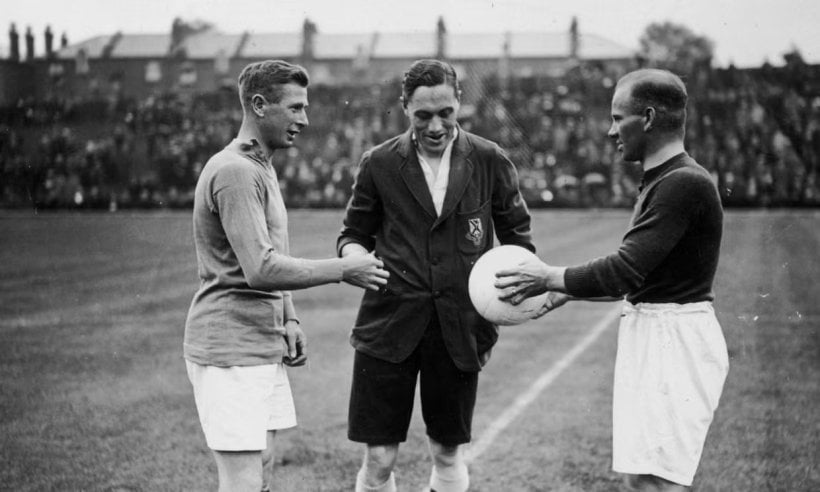
The idea of using white balls in friendly matches during pre-season training attracted the attention of several coaches, including Herbert Chapman, leading to trials. However, the results were not encouraging; in Reading, the referee and the team captain felt that the ball did not provide a clear advantage, while the team's coach described the idea as nonsense and merely a fad.
Criticism has been repeated in other grounds. At Clapton Orient, players complained about the difficulty of seeing the ball in the grey weather, while the white ball quickly lost its color in Huddersfield. At Arsenal, the experiment showed that the ball was clear for spectators, but players struggled to control it and track its path in the air.
After the trials concluded, Chapman stated that the use of the white ball was not successful enough to justify abandoning tradition, so the league returned to the brown ball, and it seemed that the idea had come to an end.
The use of a white ball during matches has returned to the forefront after years, especially with the evolution of games played under different lighting conditions. In 1949, a white ball was used during the match between England and Italy at White Hart Lane as the light faded, based on the insistence of the then FIFA president, Sir Stanley Rous.
The following year, experiments continued using balls of different colors, before a turning point came in 1951. The English Football Association allowed the use of the white ball after a new method of manufacturing it was developed, relying on a layer of white paint and another of cellulose for protection.
The white ball gained an important advantage that was not anticipated, as it became more water-resistant, unlike traditional leather balls, which could increase in weight by up to 20% on rainy days. The effect was quickly evident, as in a match between England and Wales in 1951, the white ball became a helpful factor after players struggled with a waterlogged leather ball on a muddy pitch, resulting in a 4-1 victory for England after being tied 1-1.
As time passed, the white ball began to establish its value, particularly for players who depend on short passing and technical skills. In 1953, the Football Association recommended using it from the start of the match or not using it at all. Then came the FIFA World Cup 1958, which became the first edition to use the white ball.
Thus, the idea needed more than three decades to transition from a proposal that was met with ridicule in 1927 to an accepted innovation in the world's biggest football tournament, with the white ball ultimately transforming from a rejected trend to an essential part of the modern game.


View Comments