








A story from history: A one-armed player made glory then ended violence in his life
In October 1960, Jim Malone, the chairman of Dundalk, informed the board members about a young striker who caught his eye while playing for Newry Town in Northern Ireland. Jimmy Hastie was tall and strong, possessing exceptional balance and a tremendous ability to score with his head, which is why Malone believed the club should sign him immediately.
However, one board member pointed out an unusual matter regarding the player, as he heard that Hastie only has one arm. Malone acknowledged the truth of the matter but insisted on the necessity of signing him. However, the board initially rejected the idea, telling Malone: "We are not in the business of dealing with people with unusual conditions." At that point, the club president revealed that he had already finalized the deal, having paid out of his own pocket to complete the signing, and Jamie Hastie has become a player for Dundalk.
No one knew how Hasty would perform with the team, but he quickly turned doubts into astonishment. On November 20, 1960, he played his first match at Oriel Park against Cork Celtic, attracting large numbers of spectators out of curiosity. The striker delivered an amazing performance, scoring a goal and demonstrating remarkable ability to bypass defenders, retain possession, and create opportunities for his teammates. His balance, ability to score with both feet, and proficiency in aerial duels caught everyone's attention.
Hasty was born in 1936 in the Sailortown area north of Belfast and began playing football on dirt pitches. When he turned fourteen, he got a job in a factory, but a machine there caught his left arm on his first day, and doctors had to amputate it. The injury did not stop him from returning to football, as he learned to play again and started his career in local leagues before playing with Newry Town in the second tier of Northern Ireland, where he was discovered by Malone and signed to move to Dundalk.
Hasty impressed his teammates from the start, despite the challenge of playing with one arm, which made running, movement, and balance difficult. However, it was not easy for onlookers to realize that he was missing one of his arms. In his early matches, some opponents hesitated to challenge him, but that hesitation quickly disappeared after he scored a series of goals during his first ten matches. Hasty had a special trick in aerial balls, as he would lean his amputated arm's stump against defenders to prevent them from jumping freely, while the referee could only see the amount of the hanging shirt.
Goals flowed as Dundalk climbed the league table, with increasing numbers of fans coming to watch the exceptional striker. Hasty became a hugely popular star, with children even imitating him while playing football by putting one of their arms inside their jackets. His impact was not limited to the pitch; he was known for his friendly personality and social presence, always eager to sign memorabilia and interact with his teammates, and he had a striking elegance.
In one of the human moments recounted by his colleagues, Hastie stood by Francis Callan when the latter was experiencing sadness after the sudden death of his child. Hastie sent him a message filled with love and emotions, which Callan kept, before later giving it to a father who had gone through a similar loss, after finding words in it that offered him some comfort.
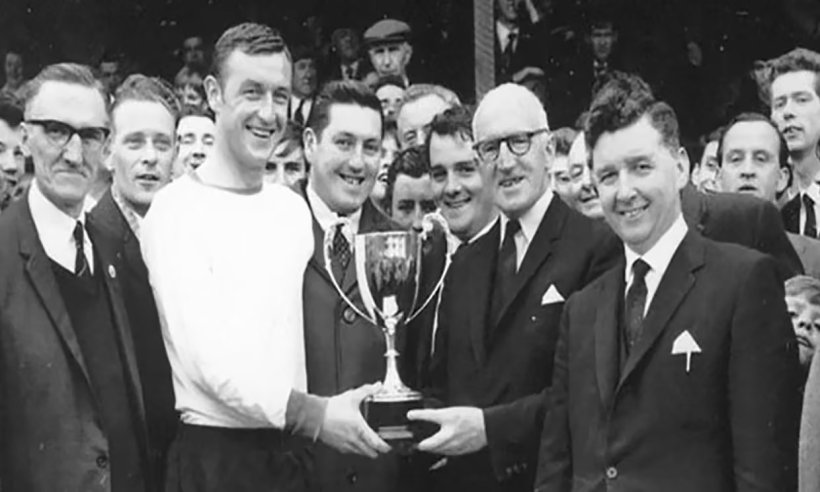
Despite injuries keeping him out of some matches, Hasty scored 103 goals over six seasons with Dundalk, and in 1963, he led the team to win the Irish league title, ending a 30-year wait for the club. Competitors' attempts to stop him were often in vain, as he was not just a scorer but also a player capable of creating space and opportunities for his teammates. Hasty's story suggests that the only player who surpassed him in more obvious achievements despite losing one of his arms was the Uruguayan Héctor Castro, who played and scored for his country in the FIFA World Cup final in 1930.
His success in Northern Ireland did not pave the way for him to England. A rumor emerged about Nottingham Forest's interest in signing him, but the transfer market at that time had not developed in the way it would later, and his loss of an arm made clubs hesitant to sign him, as he was seen as suffering from a severe disability.
After Dundalk's league title win, the team earned a chance to participate in the UEFA competition, where they faced Zürich. Dundalk lost the first leg held in Dublin 3-0 and traveled to Switzerland for the return leg amid numerous injuries and a sense of frustration. However, the team nearly pulled off a surprise, as Hasty set up a goal for his teammate Dermot Cross, then scored the second goal himself, and almost added a third with a shot from 15 yards that hit the crossbar. Dundalk won the match 2-1 but was eliminated from the competition with an aggregate score of 4-2. Nevertheless, the victory entered history as the first win for a Northern Ireland team in a European match.
Hasty continues to achieve milestones, including sharing the top scorer award in the Irish league, before retiring from football in the late 1960s. After that, he married his childhood sweetheart, Margaret, and had two sons, Paul and Martin, and worked in a betting shop.
The life of Hastie ended in a tragic manner. On the morning of October 11, 1974, while walking on his usual route to work on Proham Street in Belfast, a car stopped near him, and an armed man got out and shot him, hitting him with three bullets in the back. Hastie staggered across the street before falling, and he was only 38 years old.
The crime has been classified as sectarian, attributed to a Protestant working group, which was the name used as a cover for the Ulster Volunteer Force, and no one has been charged with the murder. His son Paul was two years old when he lost his father, and he said years later that the murder of Hastie was a message aimed at spreading fear within the Catholic community, and that everyone could be a target.
The death of Hasty has devastated his family and impoverished them, while the city of Dundalk mourns. A tribute match was held to raise funds for his family, attended by a large number of fans, many of whom paid more than the ticket price to help the family. Even after the years that have passed, his son continues to hope that those responsible for the crime will come forward and reveal the reasons behind his father's murder, so that his mother can find some peace.
In another painful scene related to the death of Hastie, a passerby, George Larmour, embraced him on the pavement and tried to comfort him as his life faded away. Fourteen years later, on October 11, 1988, George's brother, John Larmour, was killed by the Irish Republican Army on the same day of the year, while he was working in his brother's ice cream shop.
As time passed, the achievements of Jimmy Hastie turned into a tale passed down through generations, as his old photos and match reports seemed to be the only witness to his career. It was believed that footage of his matches had disappeared, until everything changed in 2015, when Paul McLean was working on a documentary about Hastie for BBC Radio Ulster and received an email from Zurich.
McLean discovered that footage from the 1963 match between Dundalk and Zürich had been used in a Swiss television news report, thus escaping loss. Suddenly, Hastie reappeared before the eyes of those who only knew him through old stories. Paul Hastie, the player's son, finally got the chance to see his father play football, confirming for himself that the story he had heard all his life was not just a legend or a fairy tale, but a real life of an exceptional player who made a place for himself in the history of Irish football before a bullet ended his career and life.
View Comments